For most ground transportation in metro Denver, rideshare is fine. A 20-minute trip across town in a midsize sedan; done. For a 2-hour trip over the Eisenhower Tunnel and Vail Pass to a Vail Valley business retreat in February, rideshare is the wrong tool. Corporate and executive travelers book a private chauffeur for Colorado mountain trips for reasons that have nothing to do with luxury — and everything to do with reliability, vehicle suitability, driver qualification, and risk management.
THE VEHICLE PROBLEM ON I-70
Most rideshare drivers operate 2WD sedans or front-wheel-drive crossovers. CDOT triggers Code 16 traction law (AWD or chains required) and Code 15 chain law (chains required on all vehicles) routinely throughout Colorado winters, sometimes for hours, occasionally for days at a time. A 2WD sedan during an active Code 15 chain law isn’t legal on I-70. The rideshare driver has three bad options: cancel the trip mid-route, pull over and wait, or continue without chains and risk a CDOT fine plus a crash.
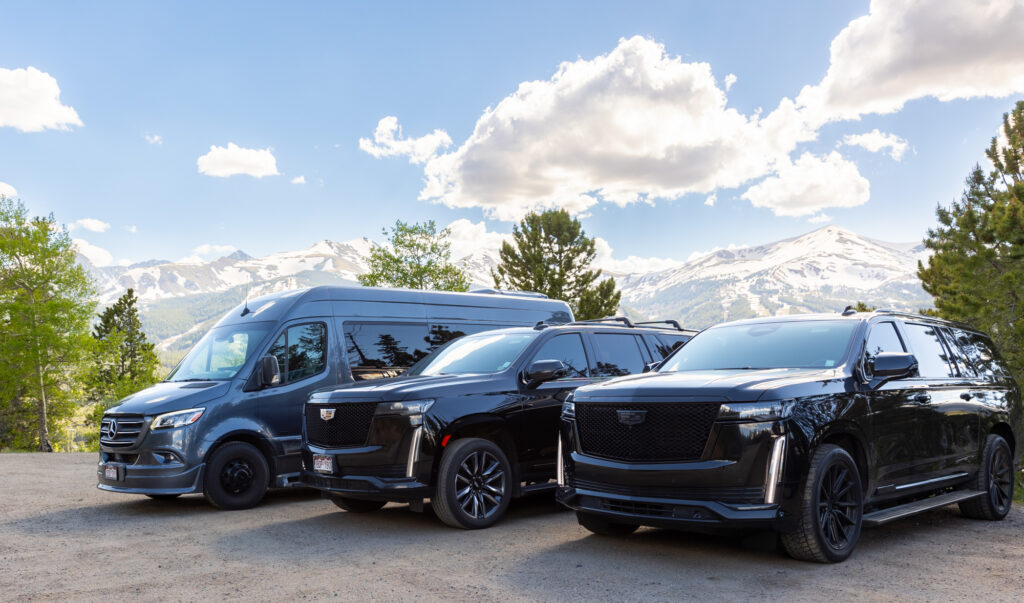
A private chauffeur company runs an AWD fleet by design — Cadillac Escalades, Chevrolet Suburbans, and Sprinters with full traction capability. Chains are carried on every vehicle during winter. The driver doesn’t have to make a judgment call about whether a vehicle is suitable for active conditions; the answer is always yes.
THE DRIVER QUALIFICATION PROBLEM
Mountain driving is a different skill set than metro driving. The variables — chain laws, weather windows, closure routing, altitude effects on engine performance, ice patches that look like wet pavement — aren’t intuitive. Drivers who don’t run mountain routes routinely make mistakes that put them and their passengers at risk. The frustration is that rideshare driver qualification is identical in metro Denver and on Vail Pass: a clean driving record, a working car, a smartphone. There is no mountain-driving certification within rideshare platforms.
A private chauffeur company hires drivers based on mountain-specific experience. Our chauffeur team includes drivers who have lived in Summit, Eagle, or Pitkin counties for years. They’ve driven I-70 in every condition. They know the alternates when the tunnel closes — Hoosier Pass, Boreas Pass, Highway 285. They read CDOT alerts on the way up. That experience is the qualification, and rideshare doesn’t have a way to require or even verify it.
THE RELIABILITY PROBLEM FOR CORPORATE TRAVEL
For a corporate traveler, missing a meeting because the rideshare driver gave up on Vail Pass is not a recoverable error. The reputational cost outweighs any savings on the transfer. A private chauffeur trip is contracted, scheduled, and tracked. The driver is committed to the route regardless of conditions. When conditions deteriorate, the driver reroutes — they don’t cancel.
For C-level executives, board offsites, M&A roadshows, and client-facing transfers, the reliability differential between rideshare and a private chauffeur is the entire reason the chauffeur exists. The cost of a missed meeting at the executive level dwarfs any saving on transportation. Corporate travel managers who do the math correctly book chauffeurs for mountain transfers as standard practice, not as a luxury upgrade.
PRIVACY AND DISCRETION
Corporate travel often involves sensitive context — confidential conversations, financial documents, M&A discussions, board materials. Rideshare drivers are not trained for, or screened for, discretion. A private chauffeur trained for executive transportation knows the basic rules: don’t make conversation unless invited, don’t acknowledge calls or documents, don’t post about clients on social media, sign an NDA on request. Our chauffeur team enforces a no-photo, no-social-media policy across all bookings as standard.No logos, no decals. Summit Black Car was founded by a former Colorado State Trooper with a background in dignitary protection — that bar runs through every chauffeur on the team, and it’s the right bar for client-facing corporate travel.
THE COST PICTURE IS CLOSER THAN MOST EXPECT
Most corporate travelers assume a private chauffeur costs significantly more than a rideshare for a mountain trip.A private chauffeured transfer in a current-year luxury Escalade is typically in the same range, sometimes cheaper. The cost differential narrows further when you account for guaranteed vehicle availability, guaranteed driver qualification, and guaranteed curb-to-curb experience.
For an executive-grade traveler, the math is rarely in rideshare’s favor on mountain trips. The premium isn’t large; the reliability difference is. For multi-day corporate retreats, multi-vehicle group transfers, or executive protection contexts, a chauffeur isn’t a “consider” — it’s required.
WHY CORPORATE AND EXECUTIVE TRAVELERS BOOK SUMMIT BLACK CAR
- AWD fleet, every vehicle current-year (2025–2026). Chain-capable in every condition; CDOT chain-law-compliant.
- Mountain-resident chauffeurs. Drivers with multi-year I-70 experience; alternate routes memorized.
- Executive-protection-grade discretion. Founded by a former Colorado State Trooper; no-photo, no-social-media policy as standard.
- Standard for high-profile or sensitive transfers.
- Multi-vehicle group coordination. Boards, sales teams, retreat delegations shuttled as a unit.
When you’re ready to book a corporate or executive transfer in Colorado, get an instant quote. For multi-vehicle, multi-day, or executive-protection-grade requests, call 970-485-3494 directly. 24/7.